Until 31 December: 100% deductible
Electric company cars that you buy or lease in 2026 are 100% tax deductible. From 1 January 2027 this drops to 95%, and then falls further every year to 67.5% in 2031.
That may look like a small step, but the percentage you get at purchase or signing applies for the entire term. In this blog we set out what is changing, which costs count, and what the difference in euros can be.
What already changed in 2026
Since 1 January 2026, new petrol and diesel cars are no longer tax deductible. This applies to purchase and lease, and also to related costs such as fuel, maintenance and insurance.
An exception exists for certain plug-in hybrids, but only for self-employed people with a sole proprietorship. Companies are not covered.
Cars bought or leased between 1 July 2023 and 31 December 2025 that emit CO2 fall under a phase-out scenario. For those cars, fuel costs are no longer deductible at all from 2028. Electricity for charging does remain deductible.
The staircase down
Deductibility falls every year, and the first steps are the smallest.
The first two steps are 5 percentage points, after that 7.5 percentage points each time.
Which percentage applies to me?
The year in which you order or sign determines your percentage. For a purchase, the year of the order form counts; for leasing, the year in which you sign the lease contract.
That percentage then applies for the whole life of the car. If you sign in 2026, you therefore keep 100% for the full term of the contract.
An example: a 4-year lease contract that you sign in 2028 is 90% deductible up to and including 2031.
Which costs count?
The deductibility percentage does not apply only to the purchase or lease itself. The same percentage applies to the related costs:
- maintenance and tyres
- insurance
- electricity for charging the car
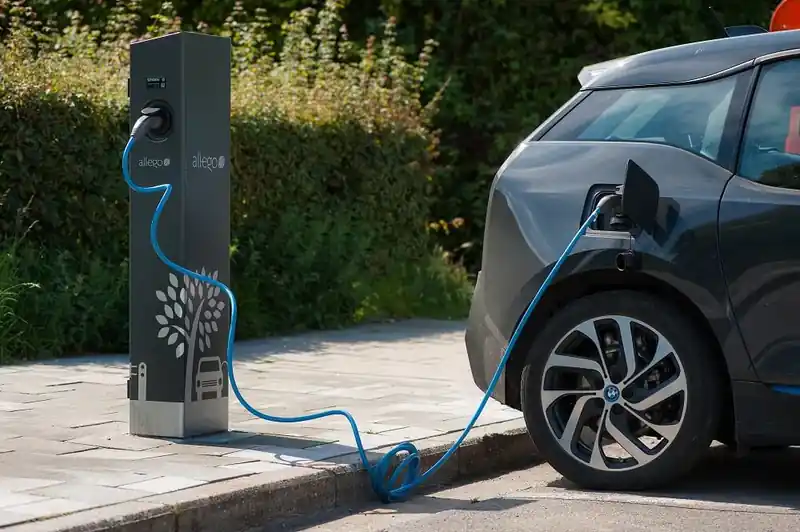
- the charging point: 100% deductible until 2029, 75% from 2030
Are you calculating the total cost of ownership (TCO)? Then also include the estimated energy costs over the full term, and not just the monthly lease price.
What it means in practice
A difference of 5 percentage points looks small, but it adds up over the term and across a fleet.
Take an annual car cost of 10,000 euros. At 95% deductibility, 9,500 euros is deductible and 500 euros is not. At 25% corporate income tax, that is 125 euros of extra tax per year, roughly 10 euros per month.
Leasing company Ayvens calculated it for a BMW iX1 over 60 months and 100,000 km:
| Average costs (euros) | Ordered in 2026 (100%) | Ordered in 2027 (95%) | Difference |
|---|---|---|---|
| Per month, 1 vehicle | 892.34 | 903.94 | 11.60 |
| Per year, fleet of 50 vehicles | 535,404 | 542,364 | 6,960 |
| Over 60 months, fleet of 50 vehicles | 2,677,020 | 2,711,820 | 34,800 |
That simulation does not take possible price increases or indexations in 2027 into account. Real costs may therefore be even higher.
Other advantages of electric
Deductibility is not the only tax advantage. Other charges are also lower for electric cars:
- Benefit in kind (BIK): the calculation takes CO2 emissions into account. Electric cars emit nothing, so the benefit in kind is lower, even though the catalogue value is often higher. For a non-electric car with the same catalogue value, the benefit in kind is easily 15 to 30% higher.
- CO2 solidarity contribution for employers: electric company cars also pay a minimum contribution (non-indexed: 25.99 euros per month in 2026 and 28.57 euros in 2027), but this remains considerably lower than for cars with emissions.
- Road taxes: the Flemish exemption for electric cars disappeared in 2026, but the rates remain lower than for fuel cars. The amounts differ by region.
Isn’t electric a lot more expensive?
The purchase price of an electric car is still often higher than that of a petrol or diesel car, but the gap is narrowing. Batteries are getting cheaper, production is scaling up and the second-hand market is growing.
Moreover, what counts is the total cost over the term. Thanks to the higher tax deductibility and lower energy costs, an electric car can work out cheaper over the full term than a cheaper car with a combustion engine. Electricity is often cheaper per kilometre than petrol, especially if you charge at home or have solar panels.
The practical hurdles are also getting lower. According to a study by Data Synergy published by BNP Paribas Fortis in January 2026, 95% of electric drivers are satisfied with the availability of charging points in Belgium. In 2024 that was still 76%.
Ready for the step to electric?
If you sign this year, you lock in 100% deductibility for the full term. Want to know what that means for your situation? Then compare your TCO now: an electric car you order in 2026 versus the same car in 2027.
At HertLease we are happy to think along with you: about when it is best to sign, which model fits and how to charge at home or at work. Feel free to get in touch.
This blog is general information and not tax advice. The rules depend on your situation (self-employed or company, region), so discuss them with your accountant or tax adviser.